The Old South Church in Boston

Going to the Dogs

A Sermon by Nancy S. Taylor, Senior Minister

September 10, 2006

Based on Mark 7: 24-37
Jesus encounters a Syrophoenician woman

Listen to this Sermonmp3 file


   The story unfolds as Jesus leads his disciples about 100 miles out of their way – and out of familiar Jewish territory. He leads them into the region of Tyre and Sidon,  into the heart of pagan territory.

   There Jesus is confronted by a pagan woman, a Syrophoenician. As she is far too desperate about her daughter’s illness to care, she dispenses with the social niceties of first century Palestine… like not talking to men in public, let alone Jewish men. 

She approaches Jesus and begs him to heal her daughter. Jesus has a problem with this, however, as she is considered one of the dogs. It was an ugly, disparaging, but also common metaphor in first century Palestine … a metaphor used to describe all Gentiles.

What is so painful about this story is that Jesus actually calls her a dog. It is because of this that this story is often regarded as one of the most difficult and disturbing stories in the New Testament. Not only does Jesus call her a dog, he appears to accept the distance and difference between himself and this woman; he appears to accept that he is superior and she inferior; he goes so far at to suggest that his healing powers are to be reserved for a better class of people: his class, his people. He brushes her aside with stingingly dismissive words: “Let the children of Israel be fed first … for it is not fair to take their food and throw it to the dogs.”

In one sense, what Jesus says is not surprising. Anyone who has been following the story knows that Jesus’ mission is focused on the Jews first … and only later to the Greeks. After all, he doesn’t deny her the crumbs … but first things are first. She can have the crumbs later, after the Jews have been fed. You could argue that his merely asking her to be patient. “You will get yours … but there are protocols and priorities to be observed.”

But there is a redemptive moment here. Jesus gives a new twist to this old, derogatory name-calling. The word he uses is the diminutive form for dogs … meaning “little dogs” or “house dogs”.[1] With his response, Jesus has at least invited the Gentiles into the house. By using this form of the word, he shifts the location of the Gentiles: they are no longer on the outside looking in. He has metaphorically relocated them to the inside … getting fed, albeit, with crumbs.

This may seem a small thing … after all, whether little dog or big dog, wild dog or pet dog, he still calls her a dog. But the road to equality and human dignity is a long and painful one. Progress does not occur over night. To move from wild dog to house dog is progress.

The woman, however, will not be denied. She keeps right on “nipping at his heels”[2] Indeed, she takes his metaphor in her teeth and runs with it. “Fine,” she says, “Children do get fed before dogs … but even dogs get the crumbs.”

She demands he help her … even if it is with crumbs. Her daughter is sick and crumbs are better than nothing. She will take what she can get.

Jesus relents. The story-teller informs us that he does, finally, heal the woman’s daughter. He has been touched and taught by this importune woman who will not keep silence and will not give up.

Today is the eve of the fifth anniversary of the terror attacks of 9/11 and the first anniversary of the hurricane that drowned New Orleans. The events of 9/11 and the effects of hurricane Katrina have opened wounds and shone a light on the differences and distances between us. In the context of the anniversaries of these two events, the 2000-year-old conversation between Jesus and the Syropheonician woman seems all too contemporary.

In this post 9/11 world the tensions between Jew and Gentile, women and men, foreigner and citizens, poor and rich are still so fraught … and the gulfs wide and deep. Indeed, even the names of the region in which Jesus and the Syrophoenician woman encountered one another, Tyre and Sidon, are printed in the papers nearly every day as tensions and fighting between ancient enemies persist.

Jonathan Sachs, the chief rabbi of London, attempts to speak into our tragically rent world by offering a way forward. In his book, “The Dignity of Difference,” he argues that the way to overcome the clash of civilizations that we are experiencing is through the concept of human dignity. He argues that the unifying element in the multiplicity of the world’s cultures and, particularly the three Abrahamic religions, is the development of human dignity.

The Syrophoenician woman was fighting for dignity for herself and her daughter when she engaged Jesus in conversation, challenged his assumptions and demanded to be seen, heard and responded to.

Rabbi Sachs argues that dignity is a biblical mandate … a gift God gives us and which we each have the right to protect and defend. And not only that, not only must we defend and protect our own dignity, but it becomes our responsibility to respect and protect the dignity of others.

As we kick off a new program year at Old South, this is a fundamental challenge and responsibility of the Christian church. On behalf of the Jesus who was touched and changed by his encounter with a stranger, we are called to also learn from others … to be touched and changed, to move in our own hearts and minds from stereotype and metaphor to human encounter.

On behalf of the God who made from one blood all the peoples’ of the earth, ours is a vocation of compassion. The world will wage its wars; it is for us to wage peace. The world will practice ancient hatreds; let us learn the vocation of reconciliation.

This is hard work … and it is work. It requires prayer and reading, talking, listening, stretching ourselves, learning from others.

One of the many baffling elements to the story of the Syrophoenician woman is the question of how she knew Jesus was in town … how she knew to approach him with her plight. After all, he and she were from utterly different worlds … so how did she hear?

            In the first century there were people who made it their business to run ahead of Jesus and to tell the news. For this, they were often treated to food and drink … or plied with whatever wares the townspeople had to offer. Many times these messengers had noisemakers, often bells, to announce they were in town and had news. They would ring their bells and allow the people to gather before they shared their news.

            So, how do we tell the news that we have … good news that Jesus is in this house and here we practice reconciliation and love? How do we tell them that we refuse to practice ancient hatreds and stereotyping … that here, on behalf of God, our vocation is love?

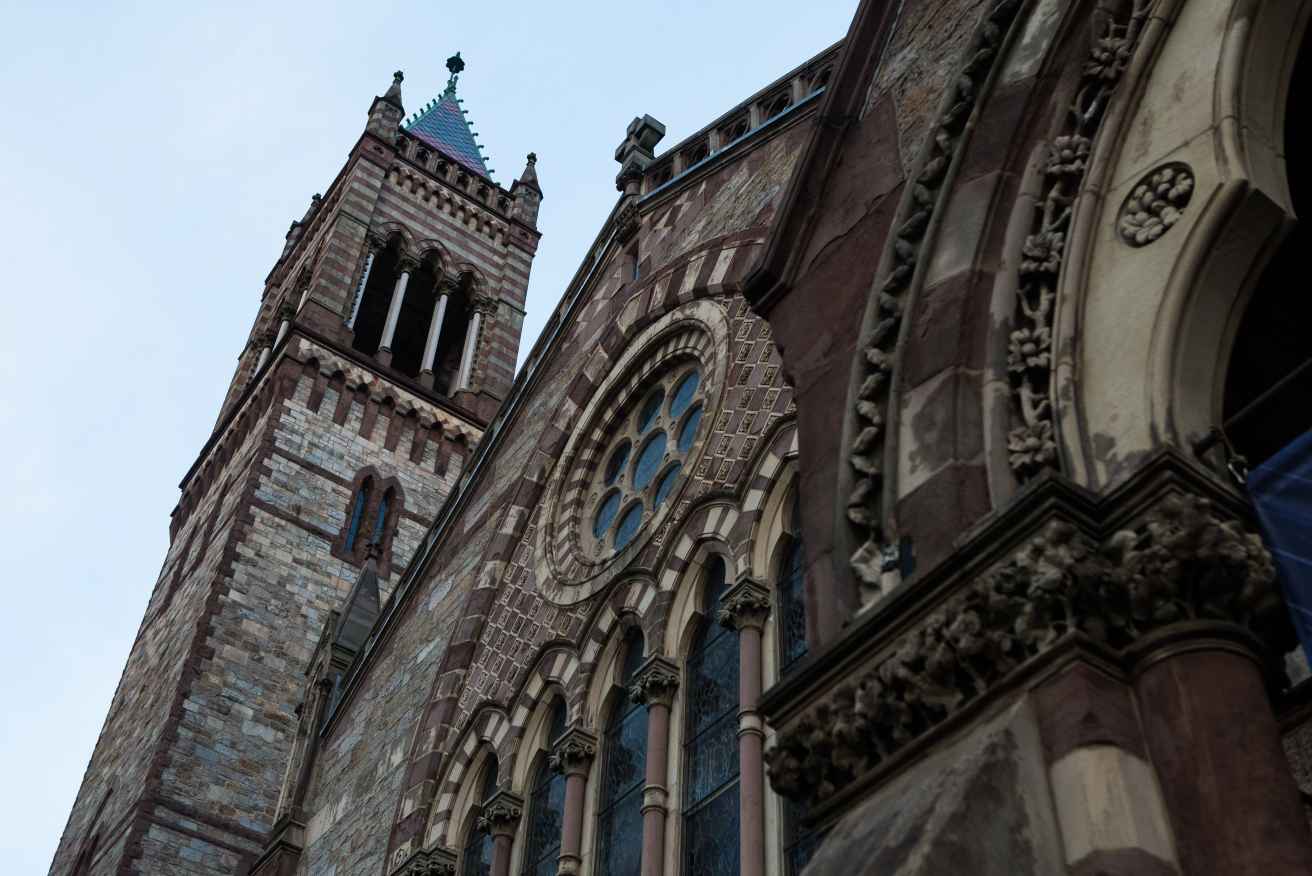
            Well, following the practice of ancient town criers, Old South has bell in our tower: handsome, 2020 pound bell. It is currently rung with a tolling hammer … and we assume that the original bell wheel simply deteriorated in the weather.

Throughout the summer our Church Moderator, Jeff Makholm, on his own initiative, has been building a new bell wheel … so the bell can be swung once again. This was a labor of love and of skill … it is wonderfully wrought and, as you can see, beautifully finished. The bell wheel will be on display for another week, then hoisted up into the tower and put to use. We will dedicate this new bell wheel, and hear the bell rung on September 24.

I’ve known for months that Jeff was building this bell wheel; he announced his intentions to the Church Council last spring. I did not know until very recently that he was dedicating it to the memory of my husband. Peter would be so proud.

May this bell ring loudly and clearly, heralding to the city that we follow a savior who teaches us to practice reconciliation, to protect human dignity, and to love one another.

bellwheel dedication


[1] I am indebted to “When the Gospel Goes to the Dogs”, by Heidi Husted, The Christian Century, August 2000

[2] Ibid


Copyright © 2006, Old South Church and by author.
Excerpts are permitted as long as full accreditation is made
to Old South Church and to the author.

Back to Sermon Page

The Old South Church in Boston
645 Boylston Street
Boston, MA 02116
(617) 536-1970