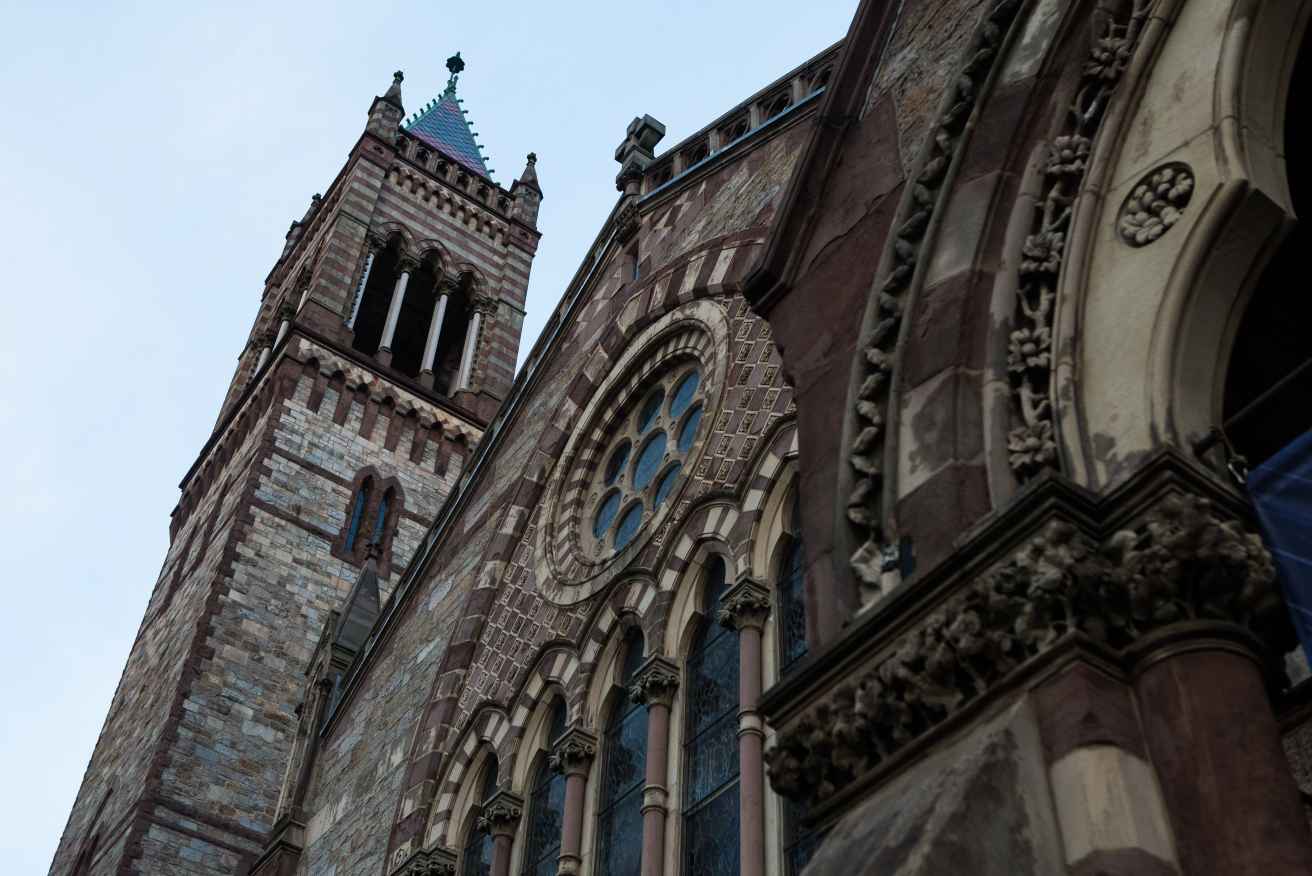
The Old South Church in Boston

A Book to Argue Over

A Sermon by Senior Minister Nancy S. Taylor

Scripture Readings: a selection of the Bible’s ‘texts of terror’ (see attached)

July 16, 2006

Listen to this Sermonmp3 file


Last Wednesday, our legislators, gathered in the Massachusetts Statehouse, were poised to take up the matter of a proposed amendment to the Massachusetts’ State Constitution: an amendment that would define marriage as between one man and one woman.

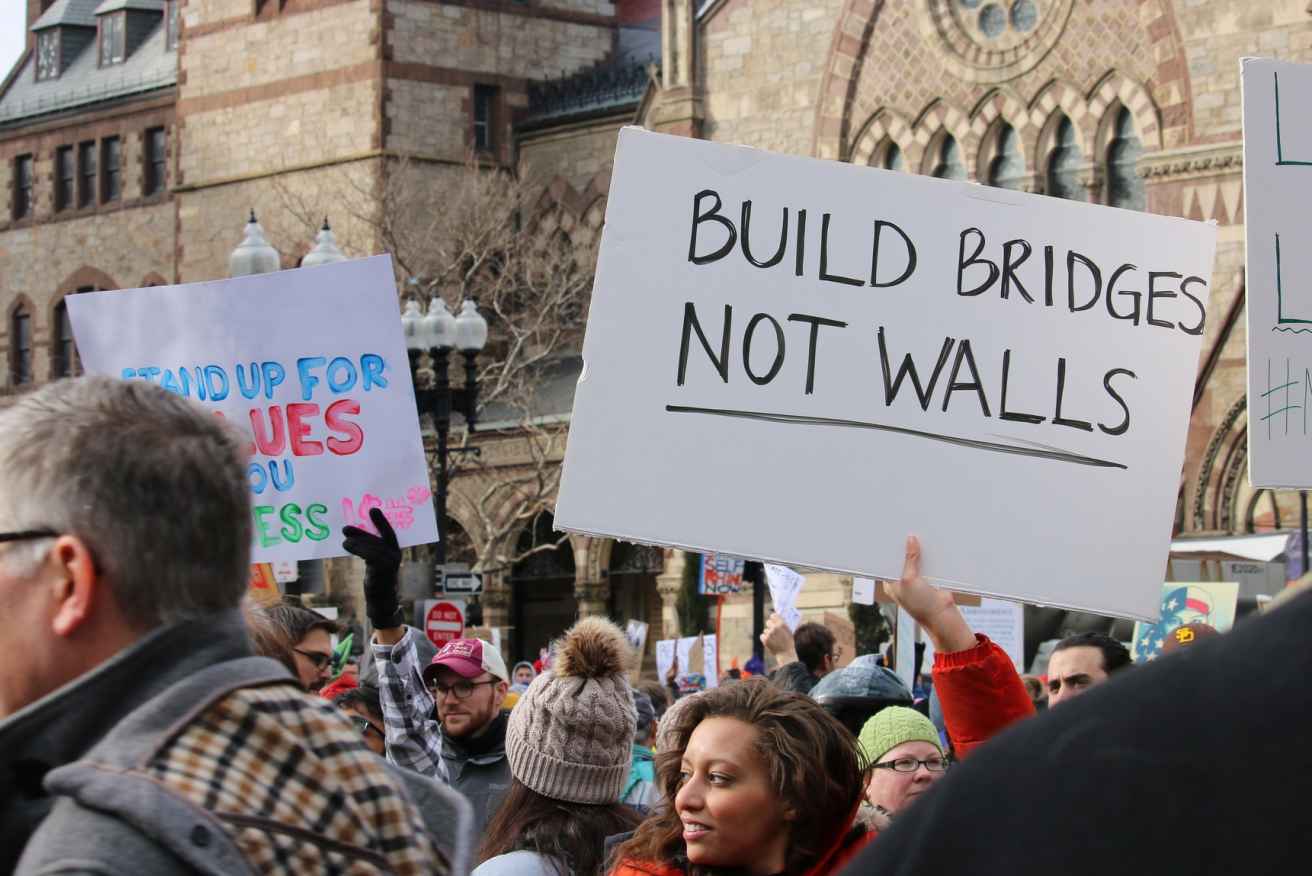
            Meanwhile, outside the Statehouse, two groups were gathered over the same issue. One group opposed same gender marriage; the other supported it. Each group numbered several hundred people.
 

Those of us who support equal marriage, were on the Statehouse side of Beacon Street. Among us there were over 20 members of Old South Church. Our opponents were on the other side.


We didn’t look too different, however. Both sides sported an assortment of street clothes, business suits, and shorts and T-shirts. Both sides carried signs and banners. There were rabbis, priests, nuns and ministers on both sides of the street. Jesus was well-represented on both sides as well.


Both sides sang songs. As it turned out, we sang the same songs. Their side started singing “Jesus Loves Me This I Know” and our side joined in. Our side started singing “O Beautiful for Spacious Skies,” and their side joined in. We continued through “When the Saints Come Marching In”, “If I Had a Hammer”, “We Will Not Give Up the Fight”, “We Shall Overcome” and “This Land Is Your Land.”


Both sides suffered equally in the scorching heat and humidity. And then, when the skies darkened, when thunder claps crashed above us, when jagged bolts of lightening flashed in the distance, and when the skies broke open: both sides got equally and utterly drenched. As it rained, the ink and paint on our homemade signs ran in rivulets of color, our cardboard posters wilted and our singing was literally drowned out.


Meanwhile, all day long, first in the searing heat of the sun and later in the drenching rain, loads of tourists passed by. Most were on Duck Boats, some were on Trolley Busses, and some were on foot. They gawked at us and took pictures. No matter what else happened that day, tourists from around the world got a dose of American democracy. In this, the Cradle of Liberty, they witnessed the impassioned, chaotic, fulsome expression of free citizens standing for what they believed to be good, true, civilizing and moral.


The vigils at the Massachusetts Statehouse on Wednesday were representative of the demonstrations and arguments that are being waged today across the country. The issue being debated is whether men should be able to marry men and whether women should be able to marry women. The question is at the heart of one of the most important religious and social institutions we know: marriage.


Who can and who can’t marry? What is love? What is good for children? Is marriage a civil right to which all are entitled or a privilege to which only some are entitled? What is the purpose of marriage? Is it procreation or companionship or economic stability or all, or none, of the above? Who should decide such things: our clergy, our courts, our legislators or the people?


These and similar questions are being hotly debated across the country, as well as in Canada some European countries. They are also being debated in churches: in meetings of synods, dioceses and presbyteries. They are being debated in rabbinic schools and Christian seminaries.


Last summer at the General Synod of the United Church of Christ, our delegates debated and voted on precisely this question. Some 4000 delegates, laity and clergy, from across the United Church of Christ, voted their support of equal marriage: 80% of the delegates were in favor; 20% were opposed.


Since that vote, however, and because of it, nearly 200 congregations have chosen to disaffiliate from the UCC. They have left in protest. They have left in disgust. They have left us claiming that, by voting in favor of same gender marriage, the delegates to General Synod declared their “independence from the Bible ....”


It should be no surprise to anyone that at the very heart of this argument, on both sides of the debate, is the Bible: the Holy Scriptures for Jews and Christians.


In an article in the recent issue of The Christian Century, Philip Jenkins relates the story of a contentious meeting of the worldwide Anglican Communion. Two Anglican bishops were participating in a Bible study. One bishop was from Africa and the other from the U.S. “As the hours went by, tempers frayed as the African bishop expressed his confidence in the clear words of scripture…” At the same time, the American bishop “stressed the need to interpret the Bible in the light of modern scholarship and contemporary mores. Eventually the African bishop asked in exasperation, ‘If you don’t believe the scripture, why did you bring it to us in the first place?’” (The Christian Century, July 11, 2006, “Liberating Word,” by Philip Jenkins)


            That encounter exposes the sensitive nature of intercultural differences as Christians gather around this one book. How should this book be read? Whose way of reading it is normative?


Some years ago, biblical scholar, Phyllis Trible published a book under the title, Texts of Terror. In her book she addressed four separate biblical stories about women:


1)     A story from Genesis about Hagar, a slave girl who was used and rejected;

2)     A story from 2 Samuel about Tamar, a princess who was raped and discarded;

3)     A story from the Book of Judges about an unnamed woman who is raped, murdered and dismembered; and

4)     A story, also from the Book of Judges, about a woman named Jephthah, a virgin who was slain and sacrificed.


Until Phyllis Trible exposed those texts to scrutiny, they had been

routinely glossed over by scholars and preachers alike. It was Trible who first dared to describe these biblical stories as brutal and terrifying. She encountered these stories from the perspectives and experience of the victims. She forced us to feel what the victims were experiencing. She dared to declare that the Bible reflects life, both in its holiness and in its horror.


            The verses that David Vogan and Lois Corman read for us this morning, represent a few of the Bible’s texts of terror. Taken from both the Old and New Testaments, these verses assume that fathers will sell daughters into slavery; that working on the Sabbath day is a violation deserving of the death penalty; that it is our duty as a congregation to stone anyone who takes the Lord’s name in vain; that if you have (what is described as) a blemish, you are not worthy to approach the altar of God; that men who have sex with men must be put to death; that women should keep silent in church.


            Many of us recognize these as terrifying texts: oppressive and brutal. Moreover, we don’t need the pope’s permission, or anyone else’s, to conclude that they represent harsh, patriarchal and primitive cultural mores to which we simply cannot subscribe.


            But not everyone views the Bible in this way. Our brothers and sisters who stood across the street from us on Wednesday, read the Bible very differently than, well, than I do. Many of them had Bibles in their hands. Some of their signs referred to biblical verses. They defend their positions on marriage and homosexuality as biblical and they readily and easily cite scripture to support their views.


            One of the biblical stories they use to defend or promote, what we would call, an anti-gay position is the story of Sodom and Gomorrah. The problem with that story is that it qualifies as one of the texts of terror. In that story, Abraham’s nephew, who lives in Sodom, is visited by two men, or two angels disguised as men. Lot invites them in and provides hospitality.


That night, however, the men of Sodom arrive at Lot’s house as an angry mob and they demand that Lot send his two guests out so that “they may know them.” (Genesis 18.5) Horrified at the thought of handing his guests over to an angry mob, instead, he places his two daughters at the mercy of the mob, saying to them, “Look, I have two daughters who have not known a man; let me bring them out to you and do with them as you please.” (Genesis 18.8)


            This is, indeed, a text of terror. And what is so terrifying – even more terrifying than the story itself – is that people who use that story to defend anti-gay position, don’t even see that in it, a father willingly offers his daughters to be gang-raped.


            There are enormous differences and tensions that divide the Christian church today. On the other hand, there is some good news: surely it is good news that although we stand on different sides of the marriage debate and the debate about gay rights, we sing the same songs. And, it is very good news, indeed, that we both read and cherish the same book … even though we read it with different eyes.


            The Bible is too good a book, and too important a book, to give up on. People like Phyllis Trible remind us there are many ways to read this book, and many lenses through which to understand its stories. 


            And, in the end, I would argue that despite it texts of terror, the Bible’s overwhelming witness is to human liberation, to justice for the oppressed and marginalized, to comfort for the persecuted, to a commitment to love, even for our enemies. The Bible’s overwhelming witness draws us into relationship, into community and into conversation, even with the stranger of whom we are so often afraid, and, indeed, even with our enemy with whom we passionately disagree.


May it be that this book keeps us struggling together, even arguing together, about those things that matter most.

By the end of the day last Wednesday, we learned that our legislators never did get to the proposed amendment to the State Constitution that would, if it were passed by voters, define marriage as between one man and one woman. They will take it up again on November 9th.


Until then, I am profoundly proud to be a part of a Christian community that supports equal marriage. I am proud to have officiated at same gender marriages. I am proud and privileged to know so many loving same gender couples who are tender parents and whose homes are secure places where family members grow and thrive.


I am reminded that ours is a minority position among the Christian churches around the world. The vast majority of Christians do not agree with us. I believe they will one day agree with us, but until then, ours is a rare and precious community … an oasis of shelter and safety in the midst of a world that can be terrifying for same gender couples.


I am convinced that despite its occasional texts of terror, there is a theme running through the whole Bible that cannot be denied, a theme that will not be silenced, a theme that trumps every other argument. That theme: God is love.


SELECTED SCRIPTURE READINGS

July 16, 2006


On slavery

Slaves, obey your earthly masters with deep respect and fear.  Serve them sincerely as you would serve Christ.  -Ephesians 6:5


When a man sells his daughter as a slave, she shall not go out as the male slaves do.  - Exodus 21.7


On the Sabbath

Six days shall work be done, but on the seventh day you shall have a holy Sabbath of solemn rest to the Lord; whoever does any work on it shall be put to death. - Exodus 35.2


On sexual relations

 If a man lies with a man as one lies with a woman, both of them have done what is detestable. They must be put to death; their blood will be on their own heads. - Leviticus 20:13


On who cannot approach God’s altar
… no one who has a blemish shall draw near (to God), one who is blind or lame, or one who has a mutilated face or a limb too long, or one who has a broken foot or a broken hand, or a hunchback, or a dwarf, or a man with a blemish in his eyes or an itching disease or scabs or crushed testicles. … he shall not … approach the altar, because he has a blemish.  - Leviticus 21


On taking the Lord’s name in vain

One who blasphemes the name of the LORD shall be put to death; the whole congregation shall stone the blasphemer.  - Leviticus 24.16


On women

… women should remain silent in the churches. They are not allowed to speak, but must be in submission, as the Law says. If they want to inquire about something, they should ask their own husbands at home; for it is disgraceful for a woman to speak in the church.  - I Corinthians 14


…the head of every man is Christ, the head of a woman is her husband, and the head of Christ is God. … For a man ought not to cover his head, since he is the image and glory of God; but woman is the glory of man. 

-1 Corinthians 11.3


Copyright © 2006, Old South Church and by author.
Excerpts are permitted as long as full accreditation is made
to Old South Church and to the author.

Back to Sermon Page

The Old South Church in Boston
645 Boylston Street
Boston, MA 02116
(617) 536-1970