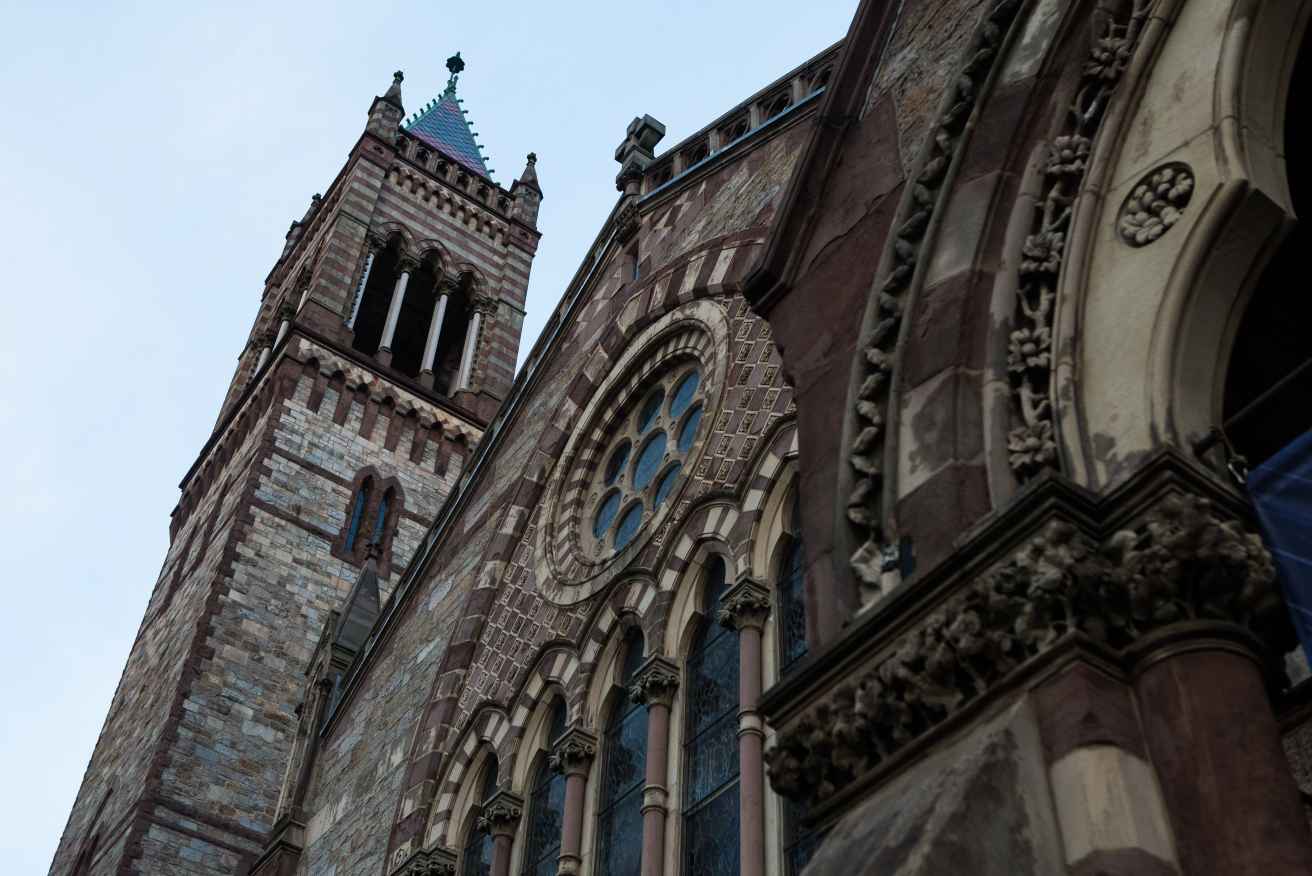
The Old South Church in Boston

A Thanksgiving Sermon

A Sermon by Rev. Nancy S. Taylor 

preached at the Old South Meeting House 

On the 143rd anniversary of the Gettysburg Address

November 19, 2006

Listen to this Sermonmp3 file


In the reading from the Old Testament this morning we overhear that, absent a king, the people of Israel did whatever they wanted. Indeed, the period to which the verse refers was among the cruelest, the bloodiest and the most barbaric in Israel’s history.

In a system that had been set up by Moses, the people were supposed to be governed by the Ten Commandments. These were the laws that had been given to them by God and by which they were instructed to order their lives. Moses had instituted a system of judges to support, interpret and enforce the people’s adherence of these Ten Commandments. But the system had fallen apart.  With Moses dead and buried and no other ruler of his caliber and authority, there was anarchy and violence.

And so it was that the people of Israel rose up and demanded a king. They pleaded for a king. Why? To restore order. And, more than that: kings can raise armies, defend the people from foreign invaders and, in turn, with a king, a nation can invade and take over foreign lands. The Israelites had noticed this happening to them. With a king, they hoped they, in turn, could do unto others what others were doing unto them.

Having gotten their wish, the people of Israel quickly learned there are kings and there are kings. Their first king, Saul, was an abject failure … he was a wreck of a man. Their second king, David, was different: he was all and more than any nation could hope for in a king … at least, that’s how Israel felt about him.

David was handsome and winsome and a remarkably effective military commander … and, at night, around the soldiers’ campfire, he was a composer and singer of psalms. David was flawed as well, of course, and he made some egregious mistakes. But there was something about him: even, with his flaws, or maybe because of them, he was an appealing and commanding presence.

David’s son, Solomon, was a pretty good king, as well. After all, it was Solomon who, when asked by God what he would ask for if he could have anything at all: asked for wisdom.

But two good kings in a row was about the limit and after that it went downhill again for Israel.
        
John Wycliffe, an English reformer living in the fourteenth century, knew well this history of the people of Israel – the original biblical people. He knew all about the anarchy and violence that held sway during the period of the judges. He knew about the flawed kings and the eventual failure of the monarchy. Nevertheless, having translated the Bible into the English language, Wycliffe boldly proclaimed that “This Bible is for the government of the people, by the people and for the people.” Wycliffe believed that given the right circumstances the people of God could govern themselves in a godly way.

That is, in fact, what our Puritan forebears also claimed. It is what they staked their lives on:  that given the right circumstances – circumstanced they could control – they could fashion a government and a nation on the Bible. Neither kings nor popes were necessary: they had the Bible. Within its pages was all that was needed for a government of the people, by the people and for the people.

That’s why Wycliffe had been so eager to translate the Bible into English and why the Puritans had been so eager to teach everyone to read. If they could just read this book, this Bible, they could fashion an ideal nation under God.

The ideal proved illusive.

Four score and sixty-three years ago today, Abraham Lincoln stood on a blood-soaked battlefield in Gettysburg, Pennsylvania. And there, in a bit of a twist of the words of John Wycliffe, Lincoln claimed that that terrible war – a war which had claimed 50,000 casualties in three days – was a war whose highest purpose was dedicated to a hope: that a nation under God might find expression in a “government of the people, by the people, (and) for the people.”

Lincoln wasn’t certain this was possible. He described the great civil war in which he and the nation were engaged as a war that would test this proposition: the proposition that a nation dedicated to liberty, equality, justice could endure.

Perhaps what is so great about the Gettysburg Address is Lincoln’s humility about whether we mortals are or will ever be able to live together in harmony for a sustained period of time. He described this nation that was “conceived in Liberty and dedicated the proposition that all men – and women – are created equal” as unfinished work.

Like everyone else in the country, the men and women of the Old South followed every development of the Civil War with keen attention. Indeed, this War of the Rebellion had reignited the spirit of patriotism in the church that had played so instrumental a part in the War of the Revolution. When Lincoln referred to the “fathers” who had “brought forth a new nation conceived in liberty,” the members of the Old South recognized their fathers.

As it had during the War of Revolution, the Old South became again a center and rallying point for prayers, speeches, patriotic sentiment and action. They understood that this nation remained a work in progress, an unfinished experiment in government … they wanted to be a part of the evolution of the idea and ideal of democracy.

Early on in the war, in the presence of a large assemblage, and accompanied by prayer, speeches and martial music, there was a flag-raising at the Old South. The flag they raised here that day bore this motto: True to our Revolutionary principles. The two ministers who were serving the Old South at the time, Dr. Blagden and Mr. Manning, both participated in the events of this day. In the words they spoke, the two men fairly represented the two positions held by different groups in the congregation.

Dr. Blagden, the senior colleague, represented those who looked forward to the “restoration of ‘order, peace and justice throughout the land’ without disturbing, necessarily, existing institutions” … in other words, slavery. He was not an abolitionist.

Mr. Manning, on the other hand, represented those who eagerly anticipated the emancipation of the slaves as indispensable to the restoration of national harmony and prosperity.

Both ministers regretted the outbreak of war. Both mourned the loss of lives. Yet, both supported the war effort. Two of Dr. Blagden’s sons served as Union soldiers. As the war heated up and new recruits were called for, Mr. Manning set off with the Forty-third Regiment to serve as its chaplain. He served well until he contracted malaria and was sent home. The Old South supported Mr. Manning, granting him a paid leave of absence, and by coming up with the money to pay another minister while he was away.

The Old South itself served as a recruiting station. In a single eight-week period, one thousand and nineteen men volunteered and were examined in the porch of the Old South. As a newspaper reported:  “the opening of these grounds (for recruitment purposes) has given an impetus to patriotic feelings and actions to a greater extent than any other one movement that has been made in Boston.” (HH p. 516)

On Saturday, April 15, 1865 news reached Boston that Abraham Lincoln had been murdered. The next day the Old South hosted a public memorial service. For reasons history does not record, Dr. Blagden was absent. Mr. Manning, seeking to create an atmosphere of mourning, took Dr. Blagden’s ministerial robe and draped it over the pulpit.

In the presence of a devastated and heart-stricken congregation – a congregation so large, it is said, that there was not an inch of standing room – Mr. Manning presided at a public service of memorial and preached a sermon in honor of a man whom history would remember as the Great Emancipator.

Today, on the anniversary of Lincoln’s Gettysburg Address, our nation finds itself once again at war. This time the war is not on our soil, but in a foreign land. And, yet, so many of the ancient questions about government and God are still at stake.

Today our nation is engaged in an effort to export democracy onto another people … trying to bring a government of the people, by the people and for the people to another people … not all of whom have determined they want it. At the same time, we are struggling ourselves to live up to and live out a functioning and earnest democracy on this soil. In the midst of it, war continues, lives are lost, and the poor of this land grower poorer and more desperate with each passing day.

A few weeks before he delivered the Gettysburg Address, and very much in the thick of a costly and bloody Civil War, President Lincoln issued a Thanksgiving Proclamation.

Unlike the one we have just heard read, issued by our Governor, Lincoln’s Thanksgiving Proclamation spoke directly and humbly from and to the actual circumstances of the nation at the time. After recounting the blessings of a beautiful and bountiful earth, Lincoln rehearsed the costs of a war of “unequaled magnitude and severity” and remarked that, despite human propensity for violence and forgetfulness of God, God has not forgotten or abandoned us.

And then, in words that ring eerily true for us today, he concluded with this paragraph: “I do therefore invite my fellow citizens in every part of the United States, and also those who are at sea and those who are sojourning in foreign lands, to set apart and observe the last Thursday of November, as a day of Thanksgiving and Praise to our beneficent Father who dwelleth in the Heavens. And I recommend to them that while offering up the ascriptions justly due to Him for such singular deliverances and blessings, they do also, with humble penitence for our national perverseness and disobedience, commend to His tender care all those who have become widows, orphans, mourners or sufferers in the lamentable strife in which we are engaged, and fervently implore the interposition of the Almighty Hand to heal the wounds of the nation and to restore it as soon as may be consistent with the Divine purposes to the full enjoyment of peace, harmony, tranquility and union.”

Friends, in the year of our Lord 2006 the United States remains a work in progress. We have tried judges, kings, and popes and have found all of them wanting. Democracy still seems the best bet, but it requires a lot of maintenance. As we gather in our ancestral home, with the souls of the saints who have gone before us infusing the very air we breathe in this Meetinghouse, hear again the words of Abraham Lincoln: “It is for us, the living … to be here dedicated to the great task remaining before us: that this nation, under God, shall have a new birth of freedom, and that government of the people, by the people, for the people shall not perish from the earth.”


Copyright © 2006, Old South Church and by author.
Excerpts are permitted as long as full accreditation is made
to Old South Church and to the author.

Back to Sermon Page

The Old South Church in Boston
645 Boylston Street
Boston, MA 02116
(617) 536-1970