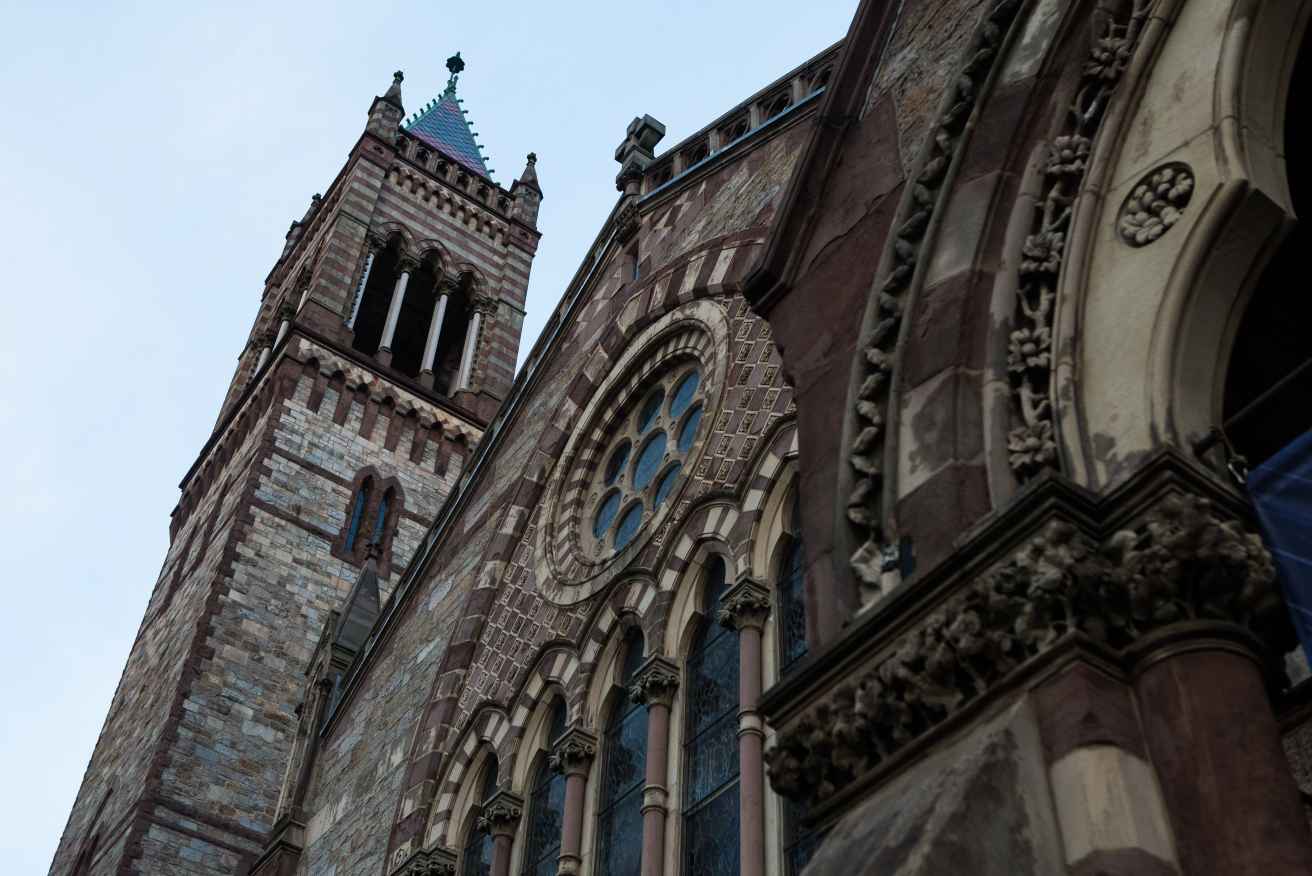
The Old South Church in Boston

House of Prayer


A Sermon by Rev. Nancy S. Taylor, Senior Minister

Based on portions of I Kings 8 

Listen to this Sermonmp3 file


“My temple shall be called a house of prayer for every nation.” (Is. 56:7b)

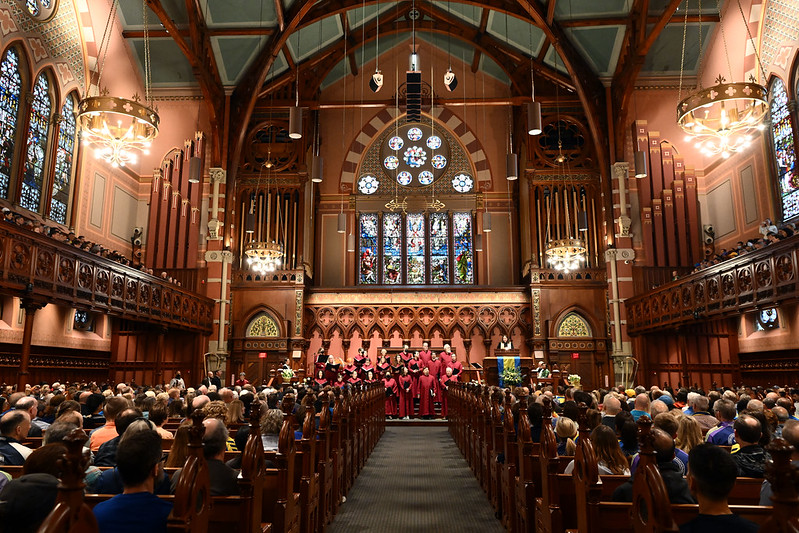
Many you of know that Old South Church is open seven days a week, free to the public. What you may not know is how rare that is. Most churches are locked up during the week; others require an admission fee.

So, who takes advantage of our open-door hospitality? Men and women who are homeless come in … but far fewer than you might imagine. The few who do come in, do so to get out of the weather, or to catch a nap in our pews or, sometimes, to find a moments’ respite from the demands of fending for themselves. And there are those who come in from a raw experience of crisis or tragedy. Sometimes they ask for a clergy person; often they just sit, cry, pray. Tourists come in. Some peruse the brochures that provide information about our history and architecture. And, locals come in; some are regulars who come here daily or weekly to pray or meditate … others have walked past our doors thousands of times … and, for one reason or another, are finally moved to enter.

When visitors come to our church, many of them approach the Reception Desk with questions. The most frequently asked question is: What kind of church is this? Variants of that question are: Is this a Catholic Church? Is this a Christian Church? Is this a Protestant Church?

Visitors want to know: What kind of church are you, anyway? Which is a much as asking: Who are you? Or, Tell us about the God you worship here.

When asked, What kind of church is this? our Receptionists respond by saying that we are Congregational Church, a member congregation of the United Church of Christ, and that we are the descendants of the Puritans and Pilgrims.

But I wonder if we shouldn’t devise a different answer. What if, when asked, What kind of church is this? our Receptionist provided this answer:

We are a house of prayer for all peoples. We are the kind of church where you can come, sit quietly and talk to God. We are the kind of church that doesn’t ask if you are Catholic or Protestant or Buddhist or agnostic. We are the kind of the church that invites our visitors to write their prayers, place them in our Prayer Box, and entrust them to our care. We are the kind of church who prayers the prayers of our visitors.

I have come to understand that our Prayer Box is one of our most elemental and far-reaching ministries. Each week one of the ministers unlocks the Prayer Box and collects the dozens of prayers that have been left with us. The minister prays the prayers there offered … and then sorts them and, protecting anonymity, includes them in our Sunday Pastoral Prayer.

The prayers that are left in our Prayer Box represent a wondrous variety of tongues and nations and religions. We have received prayers written in Chinese characters, in Arabic, in French, Spanish, German as well as in English, and in an assortment of languages I can not identify.

Some prayers are personal and familial: “Dear God, help my husband and me to love each other.” Or “Heavenly Father, I don’t have the money for next month’s rent. Help me.”

Others are passionate and global in nature: “I pray for the safety of the people of Lebanon.” Or, “Pray for Israel,” or “Dear Lord, I am praying for the women and children of Dafur.”

Some are desperate and urgent:  “Dear Jesus, my son is wresting with an addiction. Help me to help him.”

Others overflow with thanksgiving: “Thank you, God, that it finally stopped raining.” Or, “Thank you God for my new grandson.”

In the reading we heard this morning, King Solomon, prays a prayer of dedication over the Temple in Jerusalem. He says some important things in that prayer. First, he acknowledges that even though he has built a house for God, he knows that God cannot be contained in one place; that God is sovereign and free and will not and cannot be captured, owned or tamed by any religion, by any nation or, indeed, by any potentate.

That was a pretty important admission for a king who had built a grand temple. I can think of some kings and world leaders who could learn from Solomon.

Solomon’s prayer is also ground-breaking. He asks God to welcome and hear the prayers of foreigners, of outsiders, of non-Jews. In a sentiment similar to that of Isaiah and later echoed by Jesus, Solomon prayed that God’s house would be a house of prayer for all the nations, for all peoples. But it has not been so.

Throughout antiquity and still in Jesus’ day only Jews were permitted in the Temple.

Today, the Temple Mount, the location in the Old City of Jerusalem where Solomon’s Temple is supposed to have stood, is among the most contested religious sites in the world. The Temple Mount, a place holy to Jews, Christians and Muslims is carefully guarded and regulated. There are numerous restrictions about who can enter the site, and when and what they can do there. For instance, neither Christians nor Jews are permitted to pray on the Temple Mount … or to read from their holy books.

No wonder Solomon prayed this prayer and Isaiah shouted it. No wonder Jesus turned over the tables in the Temple when he discovered that the Temple was not, in fact, functioning as a house of prayer.

As we approach the fifth anniversary of 9/11, as we watch and pray over the divisions and tensions in the Middle East, as we wrestle with the deep divisions and tense relations between Christians, Jews, and Muslims … Old South Church in Boston offers this small gift of a house of prayer for all the peoples. A house of prayer that is open seven days a week, free of charge, to anyone and everyone.

It is no small thing maintaining and funding this ministry. Keeping our church open, seven days a week, free to the public, requires personnel and financial resources. This is an urban setting and all kinds of people, with all sorts of needs come in here. For safety reasons we require that when the sanctuary is open, there are two staff people on duty and in the building at all times: a receptionist and at least one sexton. Sexton is a Latin word meaning: the custodian of sacred spaces and keeper of the keys.

Our sextons not only keep track of a prodigious quantity of keys, they are custodians of the whole building. When necessary, our sextons coax an inebriated visitor outside … or working with the Receptionist, call one of the clergy, or an ambulance, or a homeless shelter, or the police.

Keeping this sanctuary open, maintaining its tender and rare vocation as a house of prayer for all peoples, is a significant commitment and investment.

So, what kind of church are we?

We are the kind of church who believes that we are custodians of this house of

God, not owners; hosts and hostesses of a sacred place, not gatekeepers or bouncers.

We are the kind of church that believes Solomon got it right when he flung open the doors of the sanctuary to the uninitiated, the unconfessed, the foreigner, the outsider, the pagan.

In the midst of world fighting over God and territory we are the kind of church that keeps the heat on and the door open and a Prayer Box at the ready.


Copyright © 2006, Old South Church and by author.
Excerpts are permitted as long as full accreditation is made
to Old South Church and to the author.

Back to Sermon Page

The Old South Church in Boston
645 Boylston Street
Boston, MA 02116
(617) 536-1970