The Old South Church in Boston

Ship

A Sermon by Rev. Quinn G. Caldwell

May 28, 2006


Acts 1: 6-26

Listen to this Sermonmp3 file


Will you pray with me?  “Lord, may the words of my lips and the meditations of all our hearts be acceptable in your sight.  Amen.”

A reading from the Gospel according to Matthew: “And when [Jesus] got into the boat, his disciples followed him.  A windstorm arose on the sea, so great that the boat was being swamped by the waves; but he was asleep.  And they went and woke him up, saying, ‘Lord, save us!  We are perishing!’  And he said to them ‘Why are you afraid, you of little faith?’  Then he got up and rebuked the winds and the sea; and there was a dead calm.  They were amazed, saying, ‘What sort of man is this, that even the winds and the sea obey him?’”[1]  Here ends the reading.

Reflecting on boats both biblical and not, Simon Jenkins, editor of shipoffools.com, “the Website of Christian unrest”, wrote this poem:

what ship plays with icebergs
and plays soft music as it sinks into the ocean?
what ship on the throw of a dice
feeds a prophet to his fishy destination?
what ship breaks its spine on the rocks
and turns the waves black with lubrication?

 a ship of fools
but there are fools and
those who seem to be

 what ship is built on a dry highland
is launched by a downpour
and flies on watery wings to the peak of a mountain?
what ship has a crew

of taxmen thieves and fishermen
who decide in the howling storm
to make a small sleeping carpenter
their captain?

yes
a ship of fools
but there are fools and
those who only appear to be[2]

“What ship has a crew of taxmen, thieves, and fishermen/ who decide in the howling storm/ to make a small sleeping carpenter/ their captain?”  The ship in Jenkins’ wonderful question is, of course, that first boatload of those who had make the foolish decision to abandon life as they knew it to follow the itinerant son of a carpenter as he lived the realm of God in a world that did not welcome such behavior.  Put another way, Jenkinds’ ship of fools is the church.

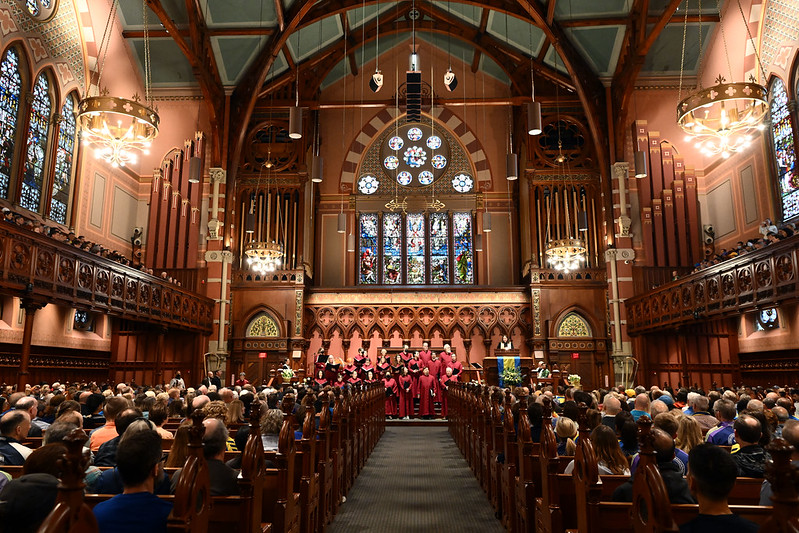
A bold and delightfully heretical statement, to be certain (I told you it came from the Website of Christian unrest), but the church as ship is an image that has been around since the earliest days of Christianity.  It can be seen painted on the walls of early Christian catacombs.  Saint Hippolytus, a martyr who lived at the turn of the second century, said, “The world is a sea in which the Church, like a ship, is beaten by the waves, but not submerged.”  The part of the church building where you are sitting, the part between the narthex, or lobby, in the back and the chancel up here in the front, is called the nave.  It’s a term that derives from the Latin word navis, from which we also get the words “navy” and “navigation”.  It means—you guessed it—“ship”.

It is a wonderful image.  The church, the body of believers, as the vessel in which we Christians ply the waters of the world.  The place where we take shelter from the storm as did Noah, or head out to brave the storm, as did those first foolish disciples of Christ.  In it, we find the aids and tools for navigation left behind by those who have traveled these waters before us.  From its lofty decks, we see that the horizon, the ending that we thought we knew when we floated alone, is no ending at all but simply the limit of our sight.

From its decks, we scan the waters for the foundering and the drowning, those who find themselves about to hit bottom, and we throw to them lifelines, shouting good news of great joy and inviting them to journey with us and our captain.  From its decks, we are fishers of people, though not with nets and hooks, but the good news of the life we know: that with our God, you can cease struggling to keep your head above water, and instead go adventuring.  We haul the drowning ones on board even as we were hauled up in our time, we pull them close, we tell them we love them, and we put them to work on the crew.

And if the church is a ship, then it is God’s breath, God’s Holy Spirit, that fills our sails and sets us running over the waves.  On this ship, there are no engines, no oars that we might move ourselves through the water.  Only the Spirit.  The Spirit is the force, the power by which we move and take our direction, and whose absence leaves us adrift.

“Adrift” is good description of the disciples when we come upon them in today’s story from the book of Acts, though “agape” might be more to the point.  Some of these ones are the very ones that had been in the boat with Jesus on the day of the terrifying storm.  Now, having died and having been resurrected, he promises them that they will receive the power of the Holy Spirit, power they must use to proclaim the good news unto the ends of the earth.  He charges them with living an enormous and fabulous adventure, and before they can even respond, so the story goes, he is taken up into a cloud and disappears.  They are left standing, dumbfounded.  Two figures robed in white, messengers from God, we presume, appear out of nowhere to tell them to stop gaping at the heavens and get to work.

The work will not be easy, and they know it.  The small boat that stood them in good stead on the Sea of Galilee while Jesus was with them in the flesh will no longer serve.  The only guidance Jesus has given them is to be patient, to wait for the power of the Holy Spirit.  They know that if they are to reach the ends of the earth with their message, if they are even to make it much beyond tomorrow, they will need to build another kind of vessel than their tiny fishing bark, one that will endure, one equipped to catch and use the power of the Spirit that Jesus has promised them.  No longer simply a movement foolish in the eyes of the world, they, this motley band of sinners, prostitutes, tax collectors, working people, and outcasts, must figure out how to become the church.

The first step they take is a good one.  It is the first step that we in the church always take when faced with a crisis.  They gather together, and they devote themselves to prayer.  Then the next step becomes clear: they turn to the question of how to replace Judas, who in betraying Jesus has chosen to face the sea alone.  They choose two that meet their initial criteria.  Then they pray to God for guidance, and, following Jewish tradition, place the decision entirely in God’s hands—some would say in the hands of luck—by tossing dice.  Matthias gets the nod.

It is a foolish way to select a new leader, and yet there is something wonderful in the deep and simple faith of it.  They have not yet received the power of the Spirit Jesus promised them, have not yet had the Pentecost experience of the Spirit’s fiery presence that we will celebrate next week.  And yet, they are prepared to believe that that Spirit is with them, that the presence of God is still among them even when Jesus no longer is, and to live their lives accordingly.

The ship of the church is not yet built, the prototypes are not even in production.  And yet here are Peter and Mary and the others, already putting on the canvas to catch the Spirit’s wind and see where it will take them.  Even in the midst of their anxiety and confusion, they raise their prayers and unfurl their souls to see on what adventure their God will lead them next.

In the eyes of the world, casting lots to find leaders, raising the sails before the ship is in shape, is a foolish way for them to have proceeded, but then again, in the eyes of the world, they were only ever a ship of fools to begin with.  “yes/ a ship of fools/ but there are fools and/ those who only appear to be”.

And after all, it worked.  The ship that Christians have been sailing through the centuries, seeking to witness to Christ in all the world, navigate the heavy seas, and throw out lines to those about to go under, this ship is still afloat.  To be sure, from time to time it has sprung leaks or been becalmed by souls close-furled and unable to catch the Spirit’s wind.  Its crew has sometimes sought to move it with nothing but their own power and ingenuity, and gotten us nowhere.  Sometimes, it has fought unholy battles with other good ships.  Sometimes, God help us, the lost and drowning have been ignored and it has seemed more like a pirate ship than anything else.  Sometimes these days it feels like a ghost ship with a skeleton crew.

But when it sails, it sails.  When souls are open and prayers are earnest, in worship here in naves, in reaching out beyond the walls and in fellowshipping within, in the grand dreams of visioning processes and the frustrating minutia of committee meetings, when our sails are well and truly raised, doesn’t our ship fly through the waters.

And by the grace of God we strike out again on God’s mission to save the lost.  The vision and the hope of the people expand beyond the old horizons.  The good news is shouted from the decks and the drowning are dragged on board and invited to work once more.  The people find a place to protect them from the surges and find themselves equal to adventuring again.

My sisters and brothers, it is good to be together on this voyage, with one another and with our God.  So, like Peter and Mary, like Joseph and Matthias and all those who have plied these waters before us, let us unfurl the sails of our souls, let us raise aloft the sails of our prayers, let us catch the Spirit’s wind that even now is blowing across the face of the waters, and together, let us go a-voyaging on this good old ship,

Amen.


[1] Matthew 8:23-27.

[2] www.shipoffools.com


Copyright © 2006, Old South Church and by author.
Excerpts are permitted as long as full accreditation is made
to Old South Church and to the author.

Back to Sermon Page

The Old South Church in Boston
645 Boylston Street
Boston, MA 02116
(617) 536-1970