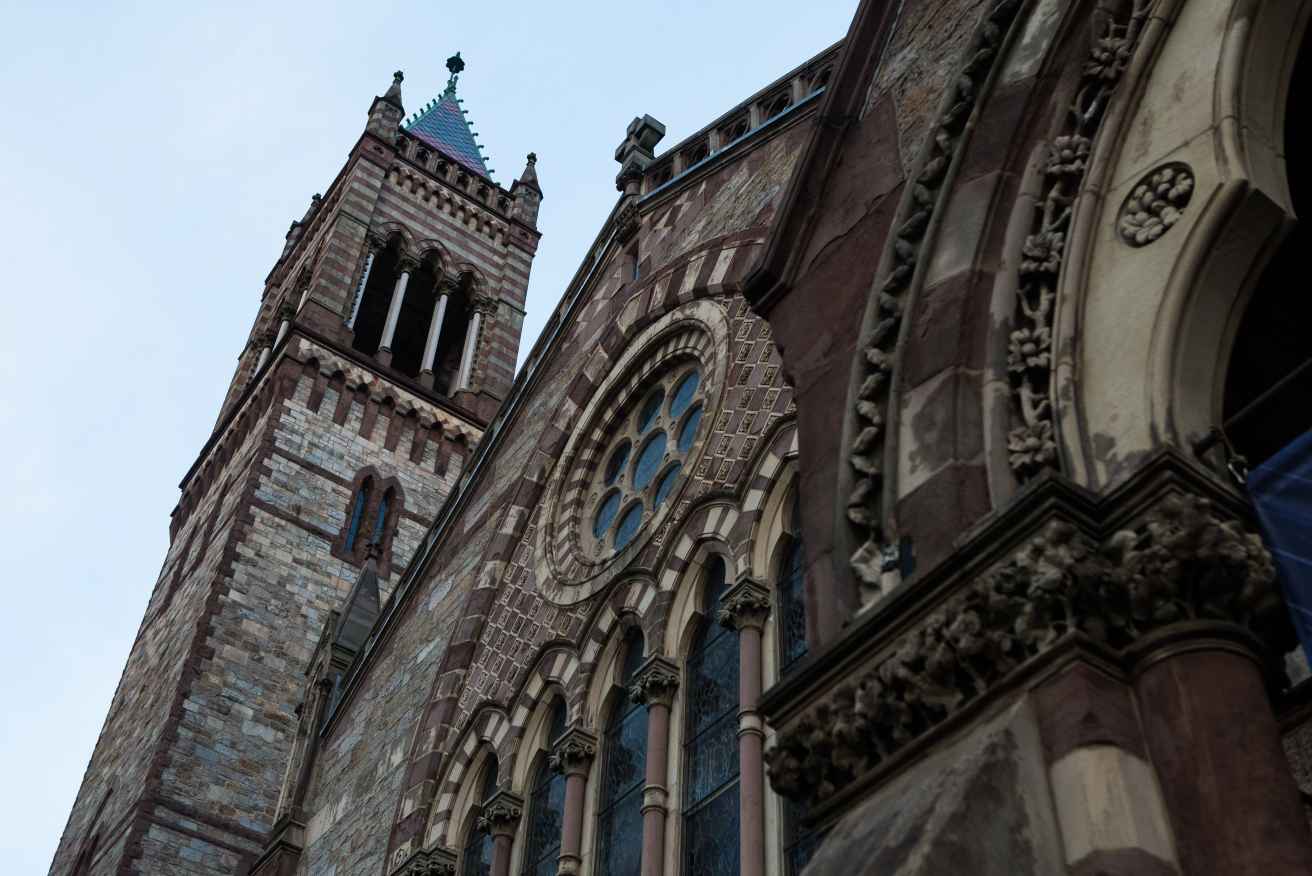
The Old South Church in Boston

Re-Form

A Sermon by Rev. Quinn G. Caldwell

October 29, 2006 (Reformation Sunday)

Hebrews 8:1-12 and Old South Church Covenant of 1669


Listen to this Sermonmp3 file


Will you pray with me?  Lord, may the words of my lips and the meditations of all our hearts
be acceptable in your sight, our rock and our redeemer.  Amen.

<>Today is Reformation Sunday, the day on which Protestant churches around the world remember and observe the courage and faithfulness of the great European Reformers.  It memorializes Martin Luther’s action in nailing his famous 95 Theses to the door of the Castle Church in Wittenburg, Germany, on 31 October, 1517.  On it, we celebrate and give thanks for all the brave men and women who heard God’s call to reform Christ’s church and who, some intentionally, some not, ended up forming new churches in the process—including the churches of our own tradition, the Congregational Way.

<>And it is a day of new beginnings for us here at Old South.  We have baptized two new members into Christ’s church this morning, and will shortly be joined in membership by another 21.  After we do so, we, too, will be a new church, re-formed and renewed by the presence of these members in our midst.
 

So as we celebrate the growth of our church and the Reformation of the wider church, it seems fitting that we pause for a moment to look at the first formation of our Old South Church, the first time God gathered us together.  Many of you already know that it happened 337 years ago, when God called 28 brave men to leave their former church home, and then formed them into a new church.  What many of you may not know is exactly how, exactly what the mechanism was by which God and those men went about creating of themselves a new church where none had been before.

<>Well, in your bulletin, you will find a copy of the way they did it: with the Covenant made by the third Church in Boston on the 12th day of the 3rd month, 1669.  It goes like this: 

We, whose names are underwritten, being called of God to joine together into a Church, in heart-sense of our unworthinesse thereof, disability thereunto, and aptness to forsake the Lord, cast off his government and neglect our duety one to another; Do in the name of Jesus Christ our Lord, trusting only in his grace and help, sollemnely bind ourselves together as in the presence of God,

Constantly to walk together as a Church of Christ, according to all those holy rules of God’s word given to a church body rightly established, so far as we already know them, or they shal be hereafter farther made known unto us.

And particularly, -- We do first of all according to the tenor of the everlasting Covenant give us ourselves and our offspring unto God our chief yea onely good; unto our Lord Jesus Christ as the onely mediator our onely spirituall head and Lord, receiving and relying on him not only as our high preist for satisfaction and Intercession, but also as our prophet to teach, and King to reigne over us; and into the holy Spirit to be a temple to him that by his dwelling and working in us, we may have, and be established in fellowship with God in Christ and one with another.

And for the furtherance of this blessed fellowship we do likewise promise to indeavour to establish among ourselves and conveigh down to our posterity, all the holy trueths and ordinances of the gospel, committed to the churches in faith and observance, opposing to the utmost of our church power, whatsoever is diverse therefrom or contrary thereunto.—

Also we do give up ourselves one unto another in the Lord, and by the will of God; hereby promising to cleave one to another as fellow members of the same body in brotherly love and holy watchfulnesse unto mutuall aedification in Christ Jesus, and to be subject in and for the Lord to all the administrations and censuers of the congregation, so far as the same shall be ordered according to the rules of God’s most holy word.

And finally we do hereby Covenant and promise through the help of the same grace, to hold promote and maintain sisterly fellowship and communion with all the churches of Saints in all those holy ways of order appointed between them by our Lord Jesus to the utmost—especially with those among whome the Lord hath set us, that the Lord may be one and his name one, in all these Churches throughout all generations, to his aeternall glory in Christ Jesus.—

And now the good Lord be mercifull unto us, Pardoning according to the greatness of his grace, as all our past sins, so especially our church sins in negligence and unfruitfulnesse of former injoyments;

and accept, as a sweet savour in Christ Jesus, this our offering up ourselves unto him in this work; filling this his house with his own glory; making us faithful to himself and one unto another, according to himself, for his holy names sake, Amen.[1]


With the recitation of those words, and the eventual signing of the names of the first twenty-eight members under them, the Third Church in Boston, later Old South Church, was formed.  That’s it.  All it took to turn this group of mere humans into the very body of Christ on earth was—a contract.

It would hardly seem enough, would almost seem profane, to claim that the agreeing and signing of a contract of behavior among a bunch of laymen is enough to create a new church and bring God to life in the world.  One expects a little more pomp: a cardinal, perhaps, or maybe just a regular bishop, or at least a grave-looking minister in black robes.  But they had no clergy there, no church hierarchy to bless them.  Just 28 faithful laymen.

But, there was a priest there to mediate in the making of their contract, they believed.  There was a priest there to bridge the gap between God and they.  For you see, those men believed that when they put their names to that document, Jesus Christ was in the room with them.  And I don’t mean the memory of Christ or the story of Christ or the teachings of Christ.  I mean they believed that Jesus Christ himself, the one whom both the author of Hebrews and the author of the covenant calls our great high priest, was there, in the room with them, telling them to sign that contract, and what’s more, signing it himself.  They believed it because he had said he would be. 

<>

People often ask me just what we in the United Church of Christ believe.  Without creeds to test our faith, without a church hierarchy making decisions about belief and organization and practice, with our freedom and wide diversity of proclamation and belief across our denomination, what can we say we believe, they ask.  I tell them that we believe in contracts.

<>Of course, the founders of our church didn’t call it a contract.  They called it a covenant.  As in Jesus’ words, “This is my blood of the new covenant.”  And as in the name we give to the Christian Scriptures: The New Testament, which is another way of saying the same thing. 

For Christians, the final and deepest expression of God’s love for us is the new covenant we have in Jesus Christ, the new and better covenant we heard about in today’s scripture reading.  Through it, signed and sealed by God in the death and resurrection of Jesus Christ, and to which we agree through our belief in the same, God promises that we will never be alone, that God will never abandon us, that wherever two or three are gathered, Jesus himself will enter in and make of them God’s body on earth, the church.  In it, God promises Godself.

<>It’s God’s contract with us, that God will not leave us alone, not when we’re alive, not when we die.  Our founders believed that through our brother Christ, our high priest, we are all of us priests, all of us able to discern and know the mind of God just as God promised, to access the love and will and direction even of the very creator of heaven and earth, and more, to join together separate lives to become God’s best home on earth, God’s very body in the world, the church.  Which is why here in the United Church of Christ, we believe in contracts. 

Each time new members join our church, we make our covenant anew.  These days, Old South’s church covenant is shorter, and plainer, and easier to follow than it used to be.  But it is still the same, for it proceeds from the same great and everlasting and divine Covenant, and, like our founders, we believe that the God that was there 337 years ago to form those men into a church will show up with us again today.

So here’s my challenge to you: as we say together the words of our modern Old South Church Covenant, expect God.  Don’t hope for God, don’t look for God, don’t wonder if God’ll show.  Expect God.  Expect that God will be here, witnessing the covenant we will make with one another, and entering into it Godself.  Expect God to show to re-form us into the Church of Jesus Christ, to set before us God’s vision, to save us from being alone.  Expect it, because God contracted that God would, and God’s word is good.  Amen.


[1] Hill, Hamilton A.  History of the Old South Church in Boston, v. 1.  Boston: Houghton, Mifflin and Company, 1889.  126-127.


Copyright © 2006, Old South Church and by author.
Excerpts are permitted as long as full accreditation is made
to Old South Church and to the author.

Back to Sermon Page

The Old South Church in Boston
645 Boylston Street
Boston, MA 02116
(617) 536-1970